The loss of one or more teeth not only affects the aesthetics of a smile and an individual’s self-confidence but also jeopardizes overall oral health. While dental implant placement is recognized as the golden, permanent solution, it is not always feasible or the optimal choice in certain specific circumstances.
This is where Dental Bridge Placement (Fixed Dental Bridge) comes into play. This is a time-tested method for replacing a missing tooth that fills the gap without requiring the surgical placement of a fixture in the jawbone.
Dr. Ehsan Birang, the best gum surgery specialist in Tehran, offers this alternative method to patients with specific conditions, in addition to specialized implant execution. In this comprehensive article, we will answer all your questions regarding the steps, types, advantages, disadvantages, and costs associated with dental bridges.
فهرست مطالب
- 1 What is a Dental Bridge? (Definition and Function)
- 2
- 3 Steps for Dental Bridge Placement: From Preparation to Installation
- 4 Types of Dental Bridges (Review of 4 Common Models)
- 5 Key Comparison: Bridge vs. Implant – Which is Better?
- 6 Major Pros and Cons of Using a Dental Bridge
- 7 Cost of Dental Bridge Placement in Tehran
What is a Dental Bridge? (Definition and Function)
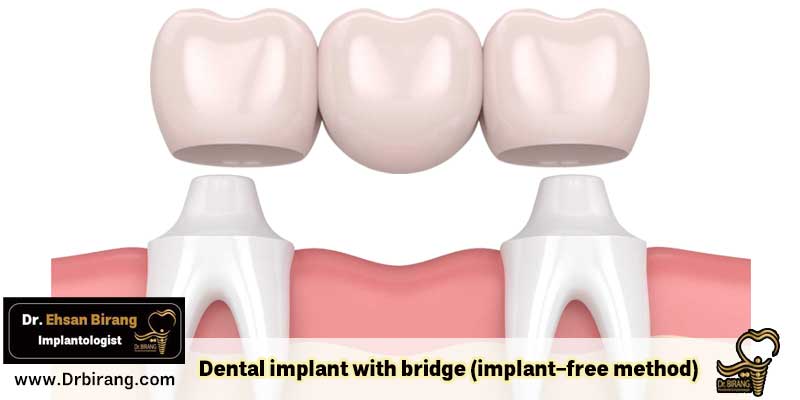
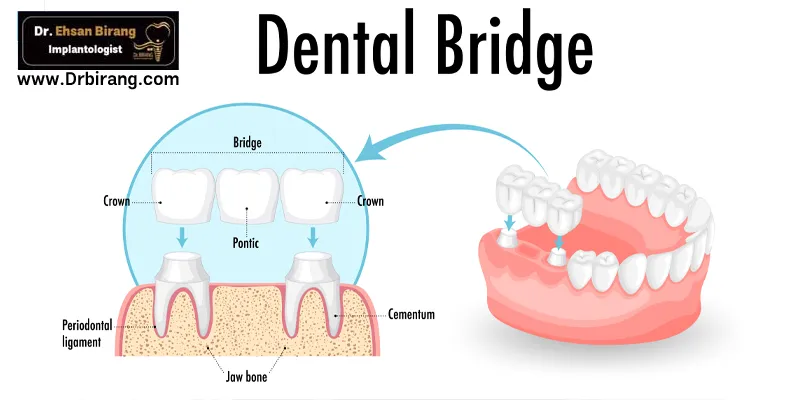
A dental bridge is a fixed dental prosthesis designed to replace one or more missing teeth. As the name suggests, this structure acts like a bridge:
-
Abutments: The natural adjacent teeth to the gap that are prepared (trimmed) and serve as supports.
-
Pontic: The artificial tooth or teeth that fill the empty space and are held in place by the abutment teeth.
These three components (two abutments and the pontic) are fused together to form a fixed unit that is cemented onto the abutment teeth using special dental adhesive. Bridges are typically made of materials such as porcelain-fused-to-metal (PFM), ceramics, or zirconia.
When is a Bridge Chosen over an Implant?
Dental bridges are usually chosen when the patient’s oral conditions are not suitable for implant placement, including:
-
Severe Jawbone Atrophy: When bone grafting or sinus lift procedures are not possible.
-
Uncontrolled Gum Disease or Infection: Although initial treatment is necessary, a bridge can be a temporary or permanent alternative in specific cases.
-
Adjacent Teeth Requiring Crowns: If the neighboring teeth are decayed, fractured, or have large fillings, preparing them for a bridge provides a “dual win” (filling the gap and crowning the weakened adjacent teeth for protection).
-
Systemic Medical Limitations: Elderly patients, or those with certain illnesses (such as uncontrolled diabetes or undergoing chemotherapy) for whom the surgical process and recovery time of an implant pose a high risk.
-
Priority for Quick Treatment: When a patient requires faster replacement compared to the time-consuming osseointegration process of an implant.
Steps for Dental Bridge Placement: From Preparation to Installation
In most specialized clinics, such as Dr. Birang’s clinic, the bridge placement process is typically completed in two main sessions:
Session One: Preparation and Impression Taking
-
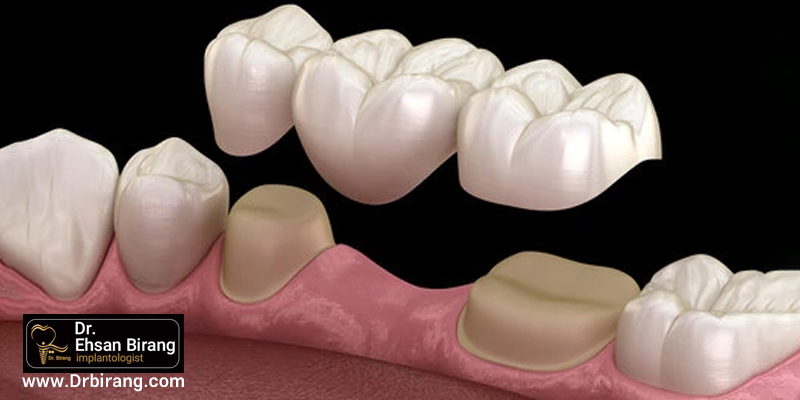
Preparation of Abutment Teeth: The specialist trims a small portion of the enamel and dentin of the natural adjacent teeth (the abutments), reshaping them. This provides the necessary space for the bridge crown to fit without pressure and ensures a perfectly aligned placement.
-
Impression Taking and Digital Scan: After preparation, a precise impression or digital scan of the prepared teeth is taken. This mold is sent to the dental laboratory for the fabrication of a custom bridge that matches the patient’s smile design and bite.
-
Temporary Bridge Placement: To preserve aesthetics and chewing function, and to prevent the adjacent teeth from shifting during the fabrication period, a temporary bridge or provisional prosthesis is placed over the area. Therefore, the patient will never leave the office without a tooth.
Session Two: Permanent Bridge Installation
-
Trial and Adjustment: Once the custom permanent bridge is ready from the lab, the temporary bridge is removed, and the final bridge is placed over the teeth for the patient and the specialist to check its alignment, color, and comfort.
-
Cementation: Upon final approval, the permanent bridge is fixed onto the abutment teeth using a strong, specialized dental cement.
-
Maintenance Recommendations: The specialist provides necessary instructions for oral hygiene with the bridge, particularly the use of specialized dental floss (like Superfloss).
Types of Dental Bridges (Review of 4 Common Models)
Dental bridges are categorized into four main types based on their attachment method and supportive structure:
Key Comparison: Bridge vs. Implant – Which is Better?
When both options (traditional bridge and implant) are possible, specialists consistently recommend dental implants as the first priority.
FeatureDental ImplantDental Bridge (Traditional)Stability and LongevityPermanent and lifelong (fixture integrates into the bone).Typically 5 to 15 years (depends on material and maintenance).Jawbone PreservationYes; the titanium post acts like a natural root, preventing bone atrophy (resorption).No; because it has no root in the bone, bone resorption continues beneath the pontic.Effect on Adjacent TeethZero; operates completely independently, causing no damage to neighboring teeth.Requires trimming; healthy adjacent teeth must be trimmed and crowned, which is its biggest drawback.Care and HygieneVery simple, exactly like natural teeth.Requires special floss (like Superfloss) to clean underneath the bridge.Initial CostMore expensiveCheaper and more affordableTreatment DurationLonger (due to necessary surgery and osseointegration time).Shorter (usually completed in two sessions).
Conclusion: Implants are the superior option due to their permanence and jawbone protection. However, a bridge is a faster, cheaper, and non-surgical solution for individuals who are not implant candidates.
Major Pros and Cons of Using a Dental Bridge
Advantages of a Dental Bridge
-
Fast Treatment: Shorter treatment period compared to implants (no need for surgery and healing time).
-
Lower Initial Cost: A bridge is generally less expensive than a single implant unit.
-
Suitable for Damaged Adjacent Teeth: If the abutment teeth require large restorations or crowns, the bridge becomes a favorable choice.
-
Prevents Tooth Shifting: By filling the gap, the bridge prevents the surrounding teeth from moving and disrupting alignment.
-
Aesthetics and Function: Restores a beautiful appearance and improves the ability to chew and speak.
Disadvantages of a Dental Bridge
-
Trimming of Healthy Teeth: The biggest disadvantage of a traditional bridge is the need to trim and sacrifice the structure of healthy or semi-healthy adjacent teeth.
-
Failure to Prevent Bone Loss: The bridge only rests on the gum and does not transmit chewing force to the bone; consequently, the underlying bone will gradually atrophy (resorb).
-
Risk of Decay Under the Crown: If proper oral hygiene is not strictly maintained, or if the specialist overlooks existing decay on the abutment teeth during placement, these teeth might decay unnoticed beneath the bridge crown.
-
Need for Replacement: Bridges are not lifelong and may require replacement after 5 to 15 years, depending on maintenance.
Cost of Dental Bridge Placement in Tehran
The cost of dental bridge placement, due to the lack of surgical requirements and simpler process, is typically more affordable compared to other tooth replacement methods, especially dental implants. The final price is determined by the following factors:
-
Type of Bridge: Traditional fixed, Maryland, or implant-supported bridges.
-
Material: Higher-quality materials like zirconia or pure porcelain are pricier than porcelain-fused-to-metal (PFM).
-
Number of Bridge Units: The number of pontics (artificial teeth) and abutment crowns required.
-
Specialist’s Expertise: The experience and skill of the specialist significantly affect the final outcome.
-
Insurance Coverage: The extent to which primary and supplementary insurance plans cover the bridge placement.
Before proceeding with any dental bridge placement (a non-implant method), you can utilize the free consultations at Dr. Birang’s specialized center to determine the best type of bridge or implant for your specific conditions and receive an accurate cost estimate.